Subtotal: ₹0
Basic Constructions
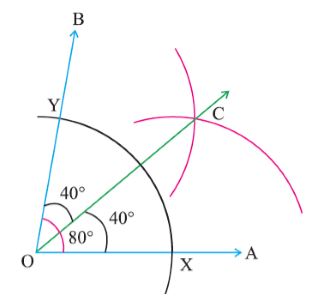
Construct the bisector of an angle:
If we have to bisect the ∠BOA, then we need to follow these steps to construct the bisector of the angle.
Step 1: Take O as the center and draw an arc by any radius intersecting the rays OA and OB at X and Y respectively.
Step 2: Now take X and Y as the center and Draw arcs that intersect each other at a point C with a radius more than (1/2) XY.
Step 3: Join OC to draw a ray which is the required bisector of the ∠BOA.
Example: ∠BOA = 80° and OC bisects it in ∠BOC and ∠COA which is 40° each.
Construct the perpendicular bisector of a given line segment:
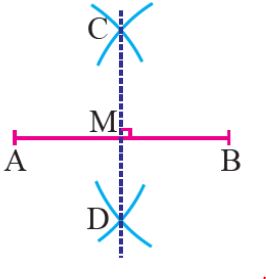
We have to bisect the given line segment AB.
Step 1: Take A and B as the centers and radius more than 1/2 of Ab and draw the arcs on both sides. construct the perpendicular bisector of a given line segment.
Step 2: These arcs should intersect each other at C and D. And join CD.
Step 3: Here CD intersects AB at point M so that M is the midpoint of AB and CMD is the required perpendicular bisector of AB. Join A and B to both C and D to form AC, AD, BC, and BD.
In triangles CAD and CBD,
AC = BC (Arcs of equal radii)
AD = BD (Arcs of equal radii)
CD = CD (Common)
Therefore, CAD ≅
CBD (SSS rule)
So, ∠ ACM = ∠ BCM (CPCT)
Now in triangles CMA and CMB,
AC = BC (As before)
CM = CM (Common)
∠ ACM = ∠ BCM (Proved above)
Therefore, CMA ≅
CMB (SAS rule)
So, AM = BM and ∠ CMA = ∠ CMB (CPCT)
As ∠ CMA + ∠ CMB = 180° (Linear pair axiom),
Now we get
∠ CMA = ∠CMB = 90°.
Therefore, CMD is the perpendicular bisector of AB.
Construct an angle of 60° at the initial point of a given ray:
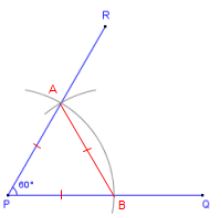
We have to draw an angle of 60° at the given point P.
Step 1: Take P as the center and draw an arc of any radius which intersects PQ at point B.construct an angle of 60°
Step 2: Now Take B as a center and draw an arc with the same radius as before which intersects the previous arc at point A.
Step 3: Now draw a ray PR in which passé through Point A and the ∠RPQ is the required angle of 60°.Join AB.
Then, AP = AB = PB (By construction)
Therefore,? ABP is an equilateral triangle and the ∠ APB, which is the same as ∠ RPQ is equal to 60°.



 */ ?>
*/ ?>
0 Doubts's